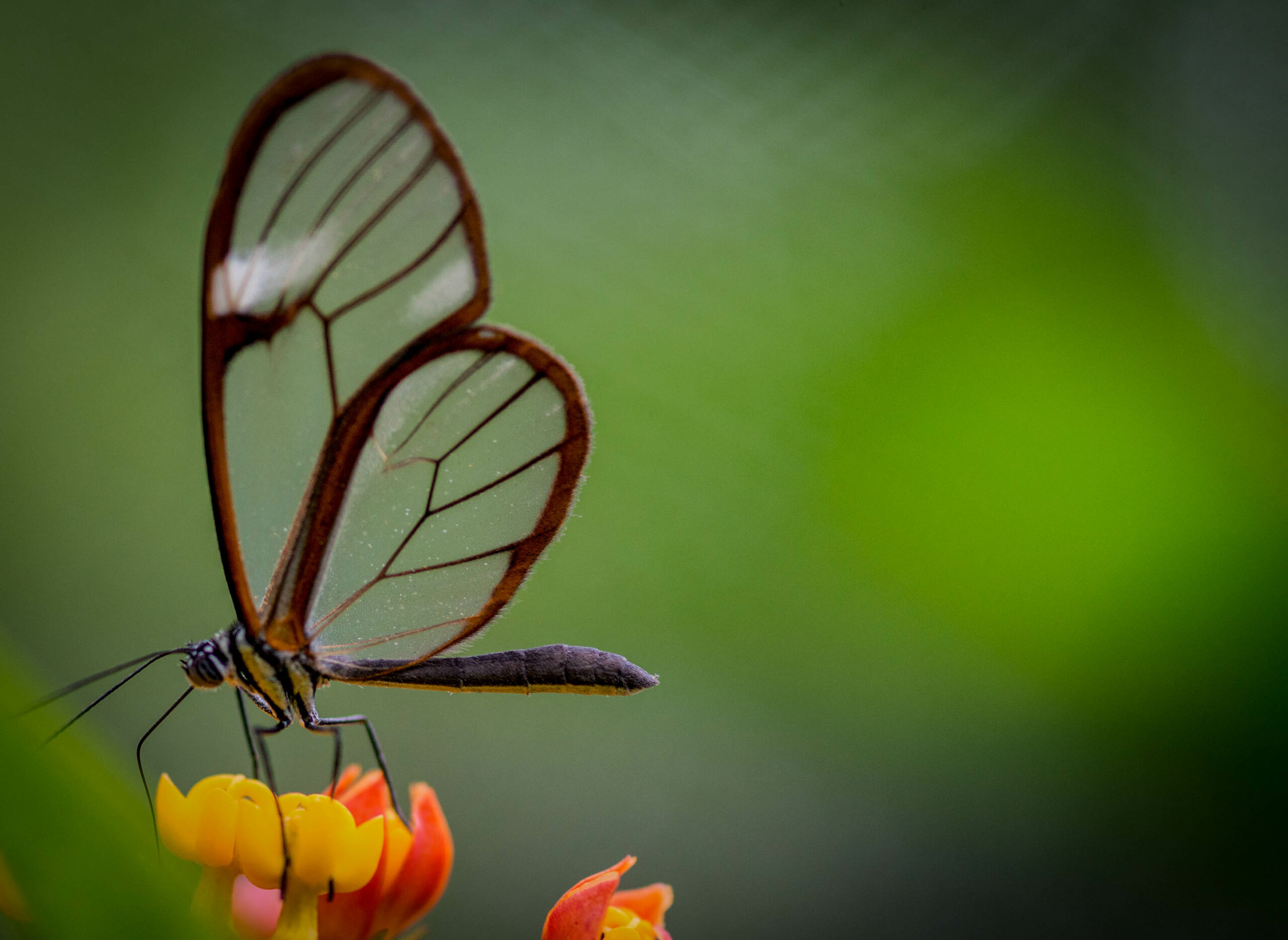




































Butterflies that are not exported are returned to the breeders for rebreeding. When the adults emerge, many will be released in large enclosures, or flight areas, that we refer to in Spanish as "viveros." The females will promptly be fertilized and proceed to lay their eggs on the hostplants that are propagated within. The butterfly farmer will either gather the eggs or the young larvae for rearing in cages until they pupaate. plants.
Photo: J.A. Brinckerhoff
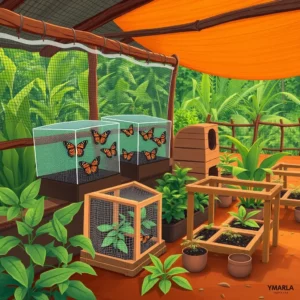
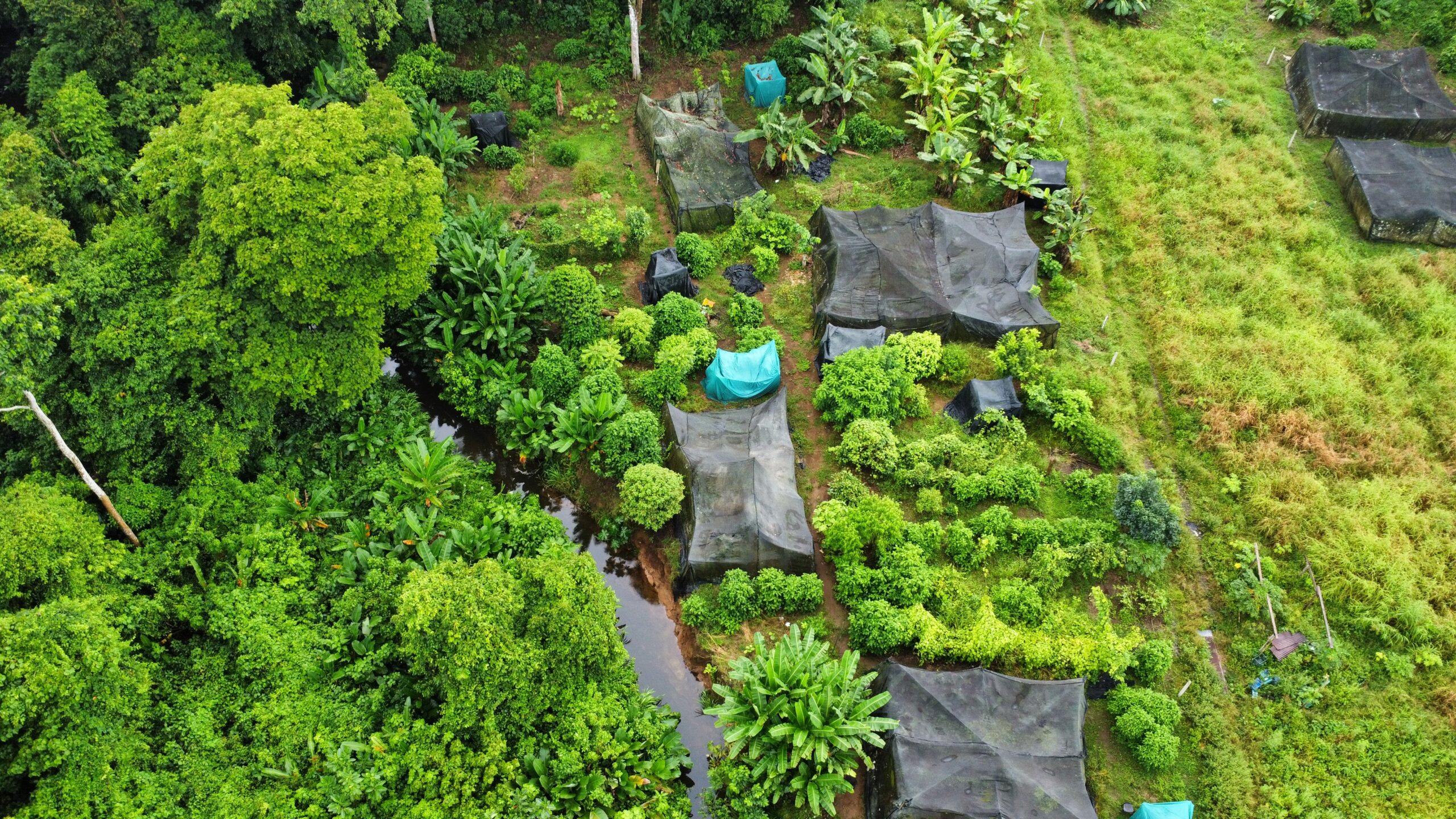
Every farmer brings a unique style to his breeding efforts. Some viveros will be veritable jungles through which one must traverse on one's hands and knees. Others are neat and regimented, like this example, allowing the hostplants ample sunlight and the farmer visual and physical access to everything that's going on. In the end, there's no right or wrong approach... just what produces healthy pupae!
Photo: J.A. Brinckerhoff
Here's a female Heliconius erato ovipositating on Passiflora biflora in the garden at The Butterfly Farm. Caked with eggs, the potted vine will be removed and placed in a cage for safe keeping from predators, These might include ants, spiders, wasps, lizards and more. When the larvae emerge, they'll get right to work munching on the leaves.
Photo: J.A. Brinckerhoff
First instar larvae of Morpho peleides. These tiny caterpillars have just emerged from ovae (eggs) that had been removed from the hostplants. In just a moment a few lucious leaves of Macuna sp. will be inserted in the petri dish with them. Once they've climbed aboard, they'll be transferred to a tree where they won't be touched for many weeks. Larvae don't eat much in their early instars, but watch out when they've grown!
Photo: J.A. Brinckerhoff
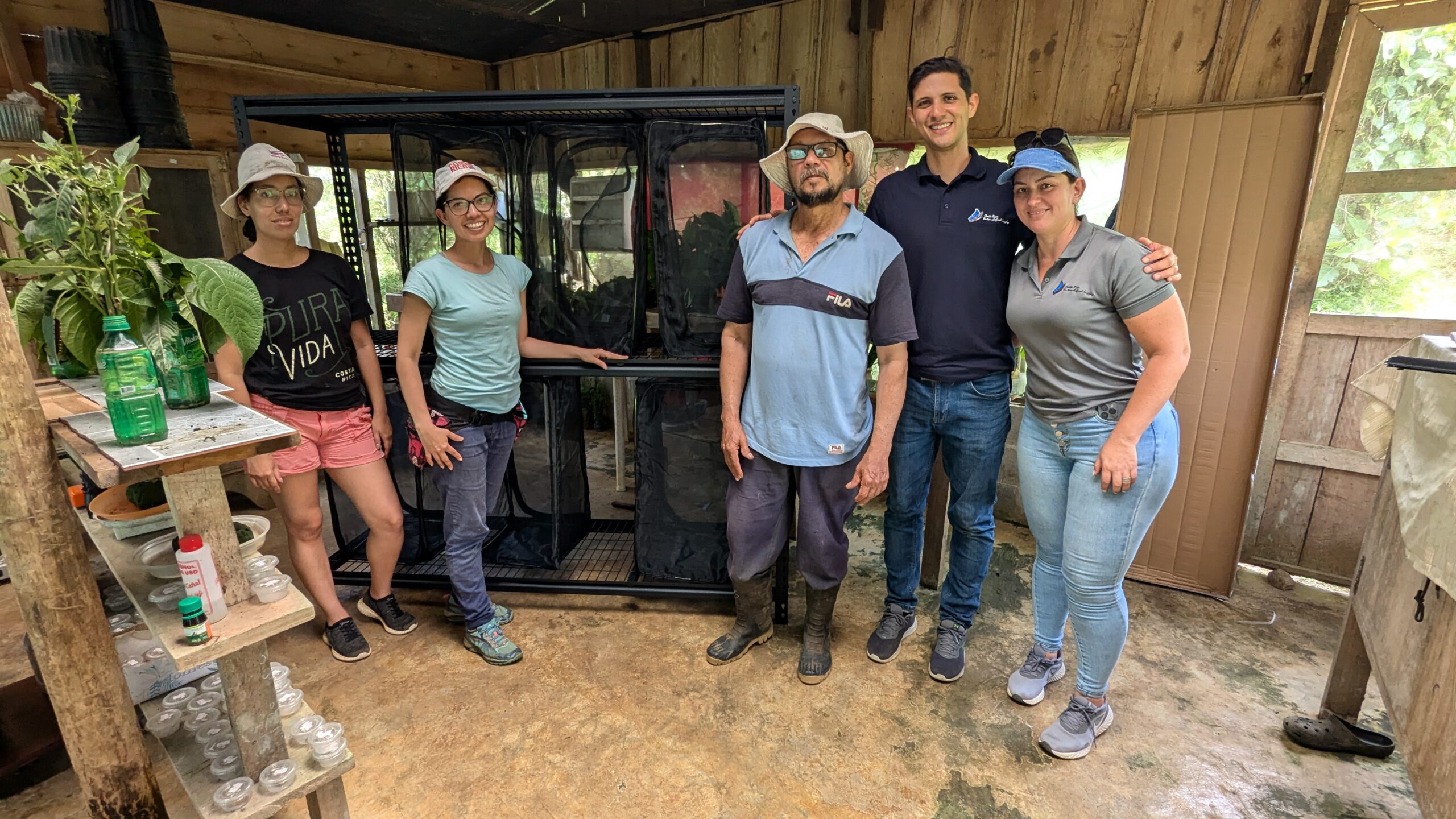
Butterfly farming has been widely acclaimed as a great means of generating employment for people in the rural areas of tropical countries. One can work at home. It engages all members of the family. It's fascinating and personally enriching. For a farmer to succeed though, one must work with extraordinary diligence. Many people in Costa Rica have created butterfly farms but relatively few have succeeded in creating a lasting livelihood.
Photo: J.A. Brinckerhoff
One effective means of farming butterflies is by rearing the larvae in bags. Here a farmer is rearing thousands of larvae of Morpho peleides on Macharium. When there are few individuals contained in each bag, this method allows the larvae to eat fresh leaves as though though the were in the wild and minimizes the amount of handling. The bags not only restrict the larvae from wandering, but also protects them from predators such as birds and wasps.
Photo: J.A. Brinckerhoff
Butterfly farming is usually a family enterprise. Grown ups may do most of the work, but children are great at spotting eggs (and spiders) under the leaves at their eye level. It is common for people so intimately connected with nature to change their perceptions and relationship with the natural world around them. Spending one's days nurturing life in the form of host plants and butterflies , rather than cutting and spraying harsh chemicals fosters a different appreciation for the richness of life.
Photo: J.A. Brinckerhoff
Working with thousands of eggs, larvae, pupae and adult butterflies -- nutrients for a wide range of predators and diseases -- in a restricted space can potentially bring a host of plagues upon a diligent farmer. Hygiene is a major preoccupation for CRES' farmers. Here a farmer stores bleach solutions of different strengths for:
- disinfecting utensils such as containers, bags, hand brooms, pincers and the like
- disinfecting living material such as eggs and hostplants before introducing them into the cages, and
- throwing away the frass (larval droppings) and discarded leaf matter that would otherwise call attention to prowling predators.
Photo: J.A. Brinckerhoff
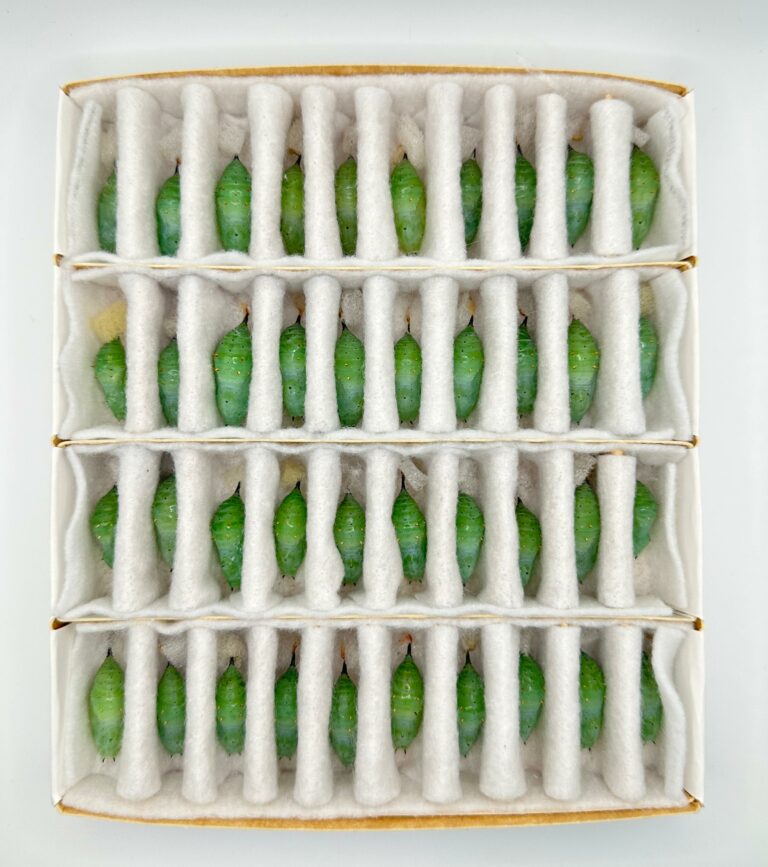
When the larvae are ready, they'll crawl up to the top of the cage that they're contained in and form their pupa. The breeder is using a Styrofoam box. If you look closely you'll see the prepupae of Heliconius sp.
forming. These are fresh pupae and will be sent to CRES' office within 48 hours.
Photo: J.A. Brinckerhoff
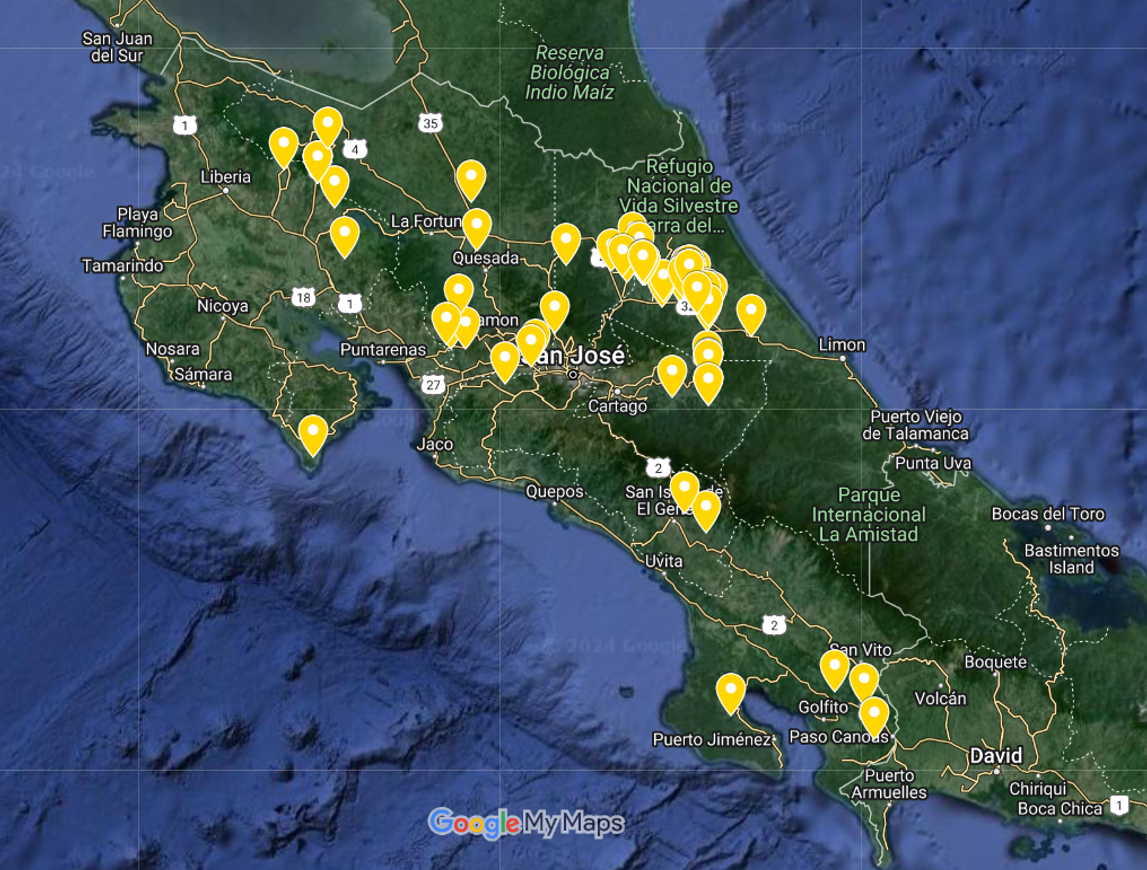
The butterfly farmers that work with CRES are widely dispersed through the rural regions of Costa Rica, though their habitats vary greatly. Some are situated high on the slopes of volcanoes where the air can be brisk while others live in more steamy regions close to sea level. Nearly all our farmers live in regions where there is electricity, municiipal water and telephone service. Some though have had to go to extremes, getting up at 3 a.m. to walk two hours to get to the road where they could catch a public bus to San José to deliver their pupae to the farm's bus driver by 7:30.
Photo: M.G. Blaese
Butterfly pupae are a highly perishable product. The butterflies emerge within a finite number of days so the must leave the country quickly. CRES exports pupae many days during the week depending on where the pupae are destined: North America, Mexico and the Caribbean, Europe or South Africa, Southeast Asia or New Zealand. While CRES often picks up the pupae at the breeders' home every few days, for other breeders this is not possible. CRES' office is always welcoming after the farmer's journey. The coffee in the reception is plentiful and hot.
Photo: J.A. Brinckerhoff
Distributing the pupae and preparing the export documentation is a finely-tuned processed at CRES. Each client has a specific list of species and quantities that he or she desires. Some orders are small while others are large. North American clients are prohibited from receiving species that don't appear on their government permits. Some shipments leave with a courier as single parcels with their own documentation while others leave in a single consoldiated shipment that leaves Costa Rica with air cargo. There is no margin for error and it all has to be at the airport by 3 p.m. in time to catch the plane. Every pupa leaves with CRES' guarantee: if it doesn't arrive in perfect condition, it will be replaced. Also, in certain condtions, if a pupa fails to emerge correctly it will be replaced.
Photo: J.A. Brinckerhoff
Before being accepted as a "CRES Quality Pupa" and accepted for export, it is inspected for:
- Size
- Color (signs of emergence or virus)
- Any deformity
- Sufficient hanging medium (our clients should never need a glue gun)
- Proper identification
If a pupa arrives in less-than-perfect condition, it may be claimed for replacement in a subsequent shipment.
Photo: M.A. Canizales
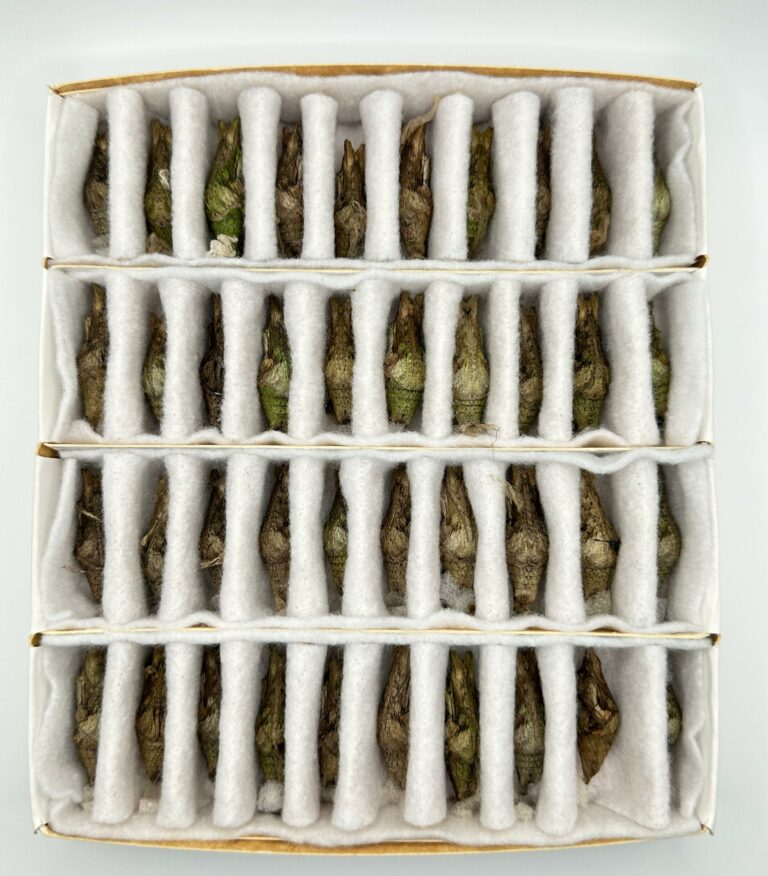
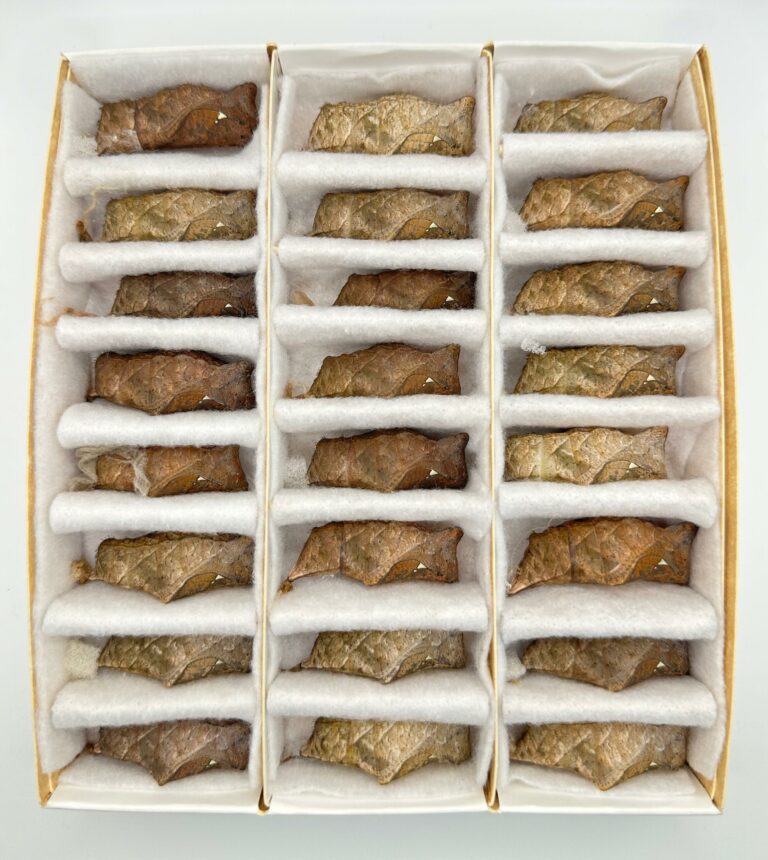
Pupae are sorted, counted and inspected before packing each client's parcel.
Photo: J.A. Brinckerhoff
Pupae ready for packing. These were destined for the Copenhagen Zoo in Denmark.
Photo: J.A. Brinckerhoff
These individual parcels are being bundled together to leave Costa Rica as a single consolidated shipment to North America. Having cleared Customs, USDA and Fish & Wildlife inspection upon arrival in the United States, they will be broken apart and forwarded to butterfly exhibitions throughout the United States and Canada.
Photo: J.A. Brinckerhoff
CRES' messenger and driver, Jesus ("Chuta Courrier") is leaving the farm with several packages for clients in the United States. CRES' office is located about 20 minutes from the country's main international airport, Juan Santamaria which greatly facilitates the shipments' rapid departure.
Photo: J.A. Brinckerhoff
The stack of paperwork that needs government official's signatures and stamps (Wildlife, Veterinary Inspection, Central Bank and others) can be daunting. Nonetheless, in the 25 years that CRES has been exporting pupae, the government has only been supportive and flexible in facilitating the export of butterfly pupae.
Photo: M.L. Sabido
CRES' butterflies have been flying in butterfly exhibits around the world for decades, amazing, entertaining and educating millions. Free-standing butterfly exhibitions, natural history museums, zoos and parks have found that few life forms appeal to the public's consciousness in the way that butterflies do. The Pacific Science Center in Seattle has recognized this by featuring butterflies prominently in their entrance.
Photo: J.A. Brinckerhoff
CRES' pupae are fast and easy to unpack and hang. This shipment has just arrived at the Garten der Schmetterlinge Sayn in Germany and the pupae are being unpacked and prepared for hanging.
Photo: J.A. Brinckerhoff
CRES provides each client with a "prealert notification" by e-mail with all the particulars (copy of invoice, tracking number, etc.). If requested, we are pleased to provide a PDF file with color photographs of the pupae and/or adult butterflies. The photographed pupae are useful for staff members (volunteers or novices) that may be unfamiliar with the subtlties of the dozens of species CRES ships and their scientific names. The photographs of the adults are often pinned with the pupae, providing the public with a quick visual reference as to what will emerge from the pupae. Your institution's preferred common names in the language of your choice canalso be included in these labels.
Photo: J.A. Brinckerhoff
May your public enjoy our butterflies!
Photo: J.A. Brinckerhoff